THIS IS AN ASPIRE PHARMA WEBSITE PAGE INTENDED FOR UK HEALTHCARE PROFESSIONALS ONLY
Please click here for Prescribing Information and further information about Fluticasone Nasal Drops (fluticasone propionate).
Adverse event reporting can be found at the bottom of the page.
About Nasal Polyps
Nasal polyps are swellings in the lining of the nose. They are usually caused by inflammation and their exact cause is not understood1.
They look like small grapes and can appear on their own or in clusters. Nasal polyps are usually bilateral; a unilateral blockage may suggest the presence of a foreign body or malignancy1,2.
Symptoms include:
- Nasal congestion
- Runny nose
- Postnasal drip
- Reduced sense of smell
(which doesn’t always resolve after treatment) - Snoring
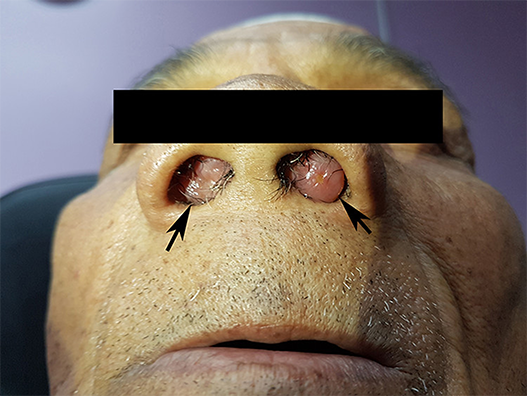
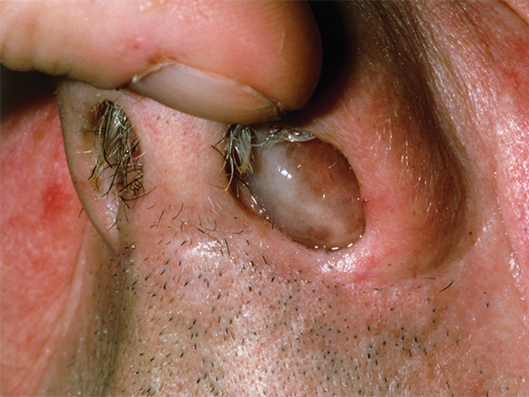
Figure 1 7, Figure 2 8
Burden

Chronic rhinosinusitis affects around 10% of the UK population1.



Of these people, up to 30% have nasal polyps1.
The chance of developing nasal polyps is between one and 20 for every 1,000 people1.
Discontinuation of Flixonase
(Fluticasone propionate Nasule 400mcg (1mg/ml) nasal drops suspension)
May 2023
GlaxoSmithKline (GSK) announced the permanent discontinuation of Flixonase Nasule Drops 400mcg (1mg/ml, nasal drops suspension)3.
Healthcare professionals were recommended to review affected patients to discuss alternative treatment, with the British Rhinological Society (BRS) publishing guidance to help with this process3,4.
Treatment Guidance
Topical corticosteroids are a widely recommended treatment for nasal polyps.

NICE CKS: Recommends topical corticosteroids (eg.fluticasone) for nasal polyps5.

British Society for Allergy and Clinical Immunology (BSACI): Recommends fluticasone as one of the choices for the long-term maintenance therapy for nasal polyps6.
Nasal polyps tend to recur, so it is recommended that treatment is continued for the long-term6.
References
- ENT UK, Nasal Polyps. Available at: https://www.entuk.org/patients/conditions/41/nasal_polyps. [Last Accessed March 2026]
- GP Online, Pictoral Case Study, Nasal Polyps. Available at: https://www.gponline.com/pictorial-case-study-nasal-polyps/ear-nose-and-throat/ear-nose-and-throat/article/1284581. [Last Accessed March 2026]
- UK Government Drug Safety Update. Available at: https://assets.publishing.service.gov.uk/media/64998b4dde8682000cbc8de3/Fluticasone_Propionate.pdf. [Last Accessed March 2026]
- ENT UK Guidelines. Available at: https://www.entuk.org/_userfiles/pages/files/guidelines/cessation_of_flixonase_nasule_drop_production_in_the_uk_nt_edit979.pdf. [Last Accessed March 2026]
- NICE Guidelines, Corticosteroids. Available at: https://cks.nice.org.uk/topics/corticosteroids-topical-skin-nose-eyes/#:~:text=Intranasal%20corticosteroids%20are%20used%20to,decongestants%20for%20better%20symptom%20relief. [Last accessed March 2026]
- BSACI guidelines for the management of rhinosinusitis and nasal polyposis. Available at: https://www.bsaci.org/wp-content/uploads/2020/01/RhinosinusitisPolyposis2008.pdf. [Last accessed March 2026].
- SAGE, Nasal Polyps and Chronic Obstructive Pulmonary Disease—An Oft Overlooked Association. Available at: https://journals.sagepub.com/doi/10.1177/0145561319856576 [Last Accessed March 2026]
- GP Online, Pictoral Case Study, Nasal Polyps. Available at: https://www.gponline.com/pictorial-case-study-nasal-polyps/ear-nose-and-throat/ear-nose-and-throat/article/1284581 [Last Accessed March 2026]
Adverse events should be reported. Reporting forms and information can be found at: www.mhra.gov.uk/yellowcard
Adverse events should also be reported to Aspire Pharma Ltd on 01730 231148.
MAT-UK-FLC-0015-1 | March 2026